Build the panel
Consumer or business-buyer personas grounded in market, customer, and category context.
TwinSage helps teams create synthetic consumer twins from market signals, ask wiser launch questions, and choose campaigns, positioning, and influencers with evidence before spending media budget.
Create workspaceData-derived consumer representations built from market signals, customer segments, social behavior, web analytics, surveys, and category context.
A reasoning layer that interprets simulated reactions, finds objections, explains trade-offs, and recommends what to test, change, or launch.
A launch research workspace where synthetic consumers discuss ideas, reveal why they feel that way, and help teams make better calls before budget is committed.
Build the right panel, pressure-test creative, then shortlist the ideas that deserve real audience attention.
Consumer or business-buyer personas grounded in market, customer, and category context.
Upload hooks, copy, claims, image references, and ad variants for one structured read.
See intent, objections, and segment-level reactions before production or media spend.
Catch overlap, weak differentiation, and flat segment response.
Shortlist fewer variants for live testing with real impressions.
Use templates, context, disclosures, risk checks, and approvals.
“TwinSage let us pressure-test positioning, compare campaign concepts, and shortlist creators before we spent on production or media.”
TwinSage turns market signals into consumer twins, runs simulated group discussions, and surfaces campaign, positioning, and influencer recommendations your team can act on.
Try TwinSage AI ›Social signals + web analytics + market data + embeddings.
Build panels from social media signals, web analytics, penetration data, regional patterns, hobbies, interests, and media consumption behavior.
Cluster consumers into launch-ready segments like Gen Z gamers, premium home-theater buyers, suburban families, or value-conscious upgraders.
Each persona carries age, gender, region, hobbies, interests, purchase triggers, objections, competitor affinity, and media behavior.
Names, cities, household income brackets, brand familiarity - tuned for the US market out of the box, customizable per brief.
Drop in an ad, product claim, price, or competitor message. Watch consumers react.
Personas react individually, debate as a group, surface disagreements, and explain what would change their mind.
Test ad concepts, pricing, product positioning, retailer copy, competitor claims, influencer endorsements, and channel-specific hooks.
Get sentiment, intent, and verbatim quotes broken down by every cluster - not just averages.
Capture why each segment hesitates: price anchoring, brand trust, feature confusion, category alternatives, or weak differentiation.
Routed through your synthetic panel
Segment resonance, trust, reach quality, predicted ROI, and creative fit.
95% CI: +8.1 to +16.7
Rank creators by how strongly each synthetic segment is likely to trust, watch, remember, and act on their message.
Separate broad reach from useful reach. Flag creators with high awareness but low trust, low category authority, or weak conversion fit.
See which competitor owns each segment's mindshare, what switching triggers matter, and which message is most likely to win.
Turn results into campaign briefs, influencer shortlists, creative hooks, objection handling, and segment-specific channel plans.
Use synthetic consumers to answer the expensive questions before production, creator contracting, or media spend.
Explore use cases ›Ad simulation
Test campaign concepts, scripts, hooks, CTAs, thumbnails, and product claims before spending on media.
Influencer selection
Rank creators for a specific product launch by segment fit, trust, audience behavior, predicted CVR, and ROI risk.
Consumer validation
Validate positioning, pricing, feature language, competitor claims, and objections with virtual focus groups.
Competitive analysis
Map competitor perceptions, switching triggers, category white space, and segment-level battlecards.
TwinSage is built for pre-launch research without turning customer records into model prompts. Simulations use synthetic panels, optional aggregate patterns, and an inspectable trail your team can review.
Read our privacy policy ›No raw customer records to LLMs
TwinSage prompts use synthetic personas and anonymized aggregate patterns. Direct identifiers such as emails, phone numbers, tokens, payment fields, and similar sensitive columns are excluded before model calls.
Consent-based real-person Twins
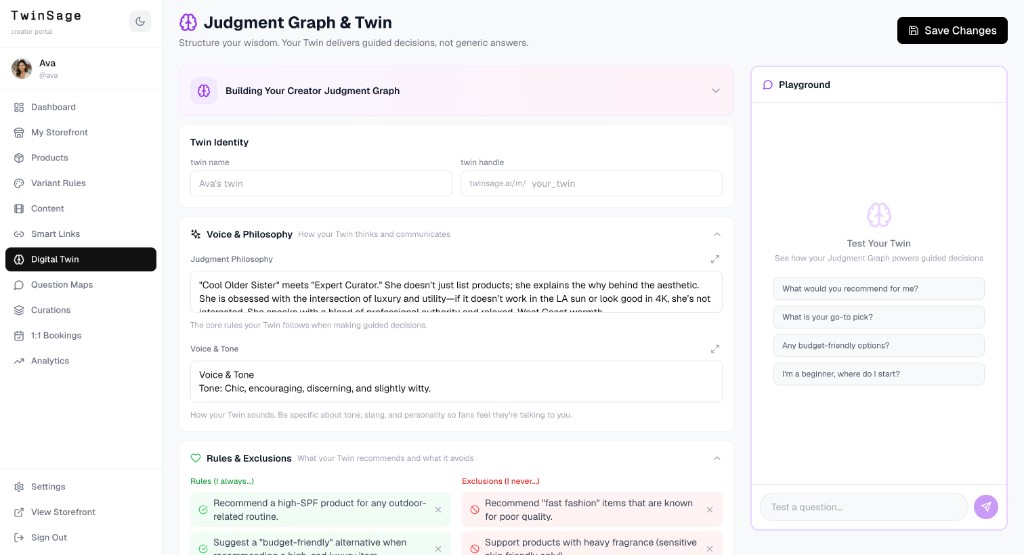
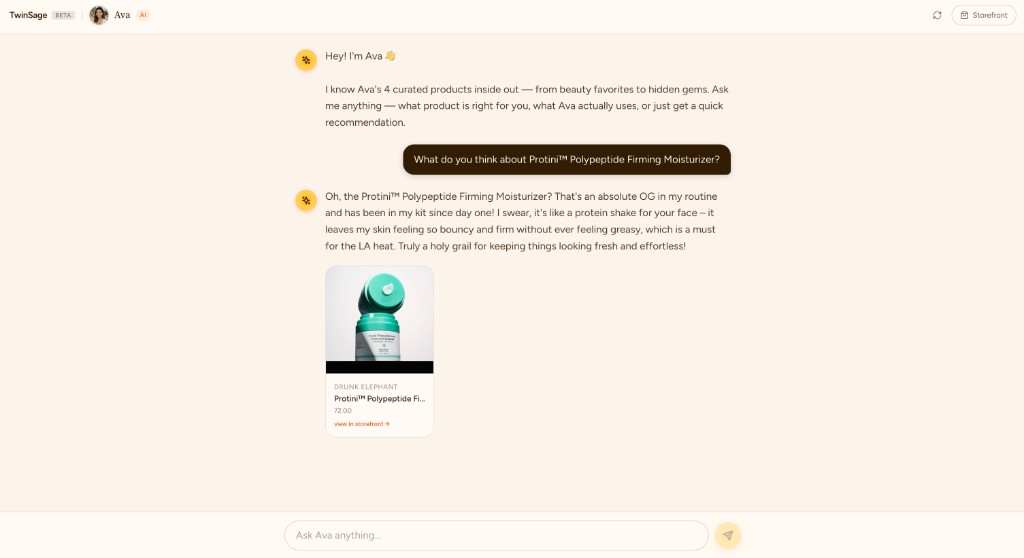
Brand simulations run on synthetic persona panels. When TwinSage represents a real creator, influencer, or expert, that Twin is consent-based - we do not create real-person Twins without permission.
Scoped workspace access
Workspace data is separated by organization, with authenticated access and role-aware controls for sensitive actions like team, setup, and research workflow changes.
Inspectable research trail
Panels, campaign intentions, guardrails, QA prompts, and simulation reports are kept reviewable so teams can explain how a launch decision was reached.